Your product meeting ends with a decision: “We need the app on both iOS and Android.” Then someone says:
Use Flutter. It is faster.
Someone else says:
No, React Native is better because everyone already knows JavaScript.
Five minutes later, you have 14 browser tabs open, three benchmark charts, two Reddit threads, and somehow you are now debating rendering engines instead of your customers.
That is the wrong way to choose. For businesses planning a new product, IntuivoTech Mobile App Development Services can help evaluate native and cross-platform approaches based on product requirements. In 2026, Flutter vs React Native is no longer a simple contest about which framework can build a fast mobile app. Both can. The more important questions are:
- What are you building?
- How custom is the UI?
- Which skills does your team already have?
- How deeply will the app use native device capabilities?
- How much platform-specific work will remain?
- Who will maintain the app two years from now?
- What happens when the framework, operating systems, or third-party libraries change?
The best framework is not the one that wins the most comparison tables. It is the one that creates the fewest unnecessary compromises for your particular product. This guide explains how Flutter and React Native differ in 2026 and gives founders, product leaders, and businesses a practical way to choose between them.
For the wider planning context, start with the Complete Mobile App Development Guide or review IntuivoTech Mobile App Development Services.
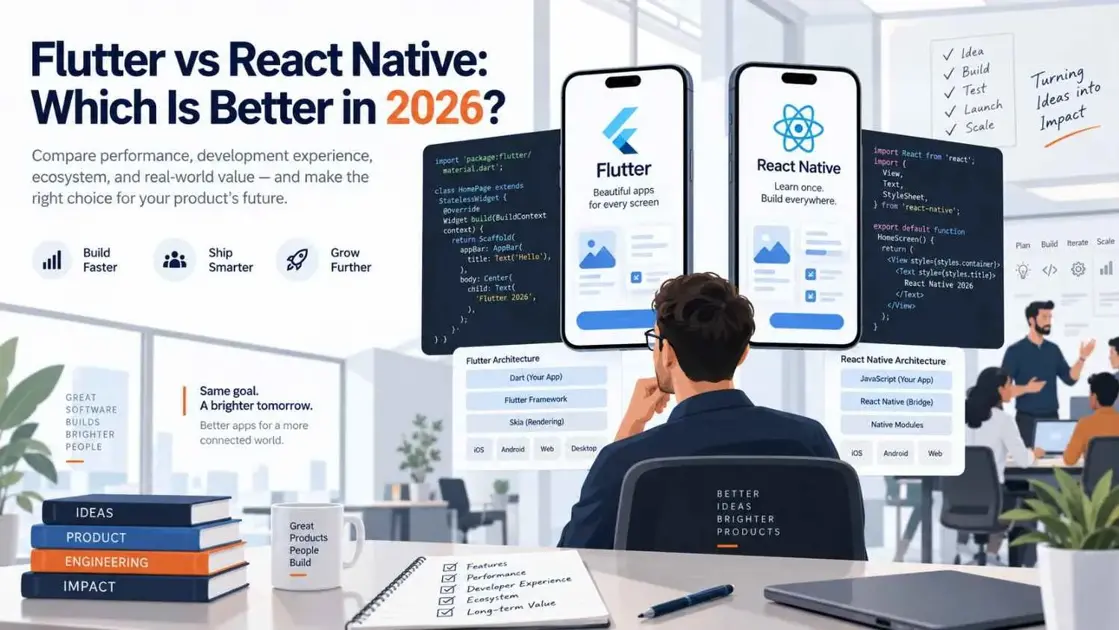
IMAGE 1 — Flutter vs React Native 2026

Flutter vs React Native: The Short Answer
If you need a quick decision: Consider Flutter when:
- Visual consistency across platforms is a major priority.
- The application has a highly customized interface.
- You are comfortable building around Dart.
- You may eventually target mobile, desktop, or web from the broader Flutter ecosystem.
- You want strong control over how the UI is rendered.
Consider React Native when:
- Your developers already know React, JavaScript, or TypeScript.
- Your organization has an existing React ecosystem.
- You want to reuse familiar development patterns.
- Hiring from the broader JavaScript/React talent pool matters.
- Your product needs to work closely with native platform components.
Consider native iOS and Android instead when:
- Platform-specific functionality dominates the product.
- The application relies heavily on advanced device APIs.
- Extremely deep native integration is central to the experience.
- iOS and Android experiences intentionally need to behave very differently.
There is no universal winner. That is the first thing your cross-platform app development strategy should get right.
Flutter vs React Native: Quick Comparison
| Factor | Flutter | React Native |
|---|---|---|
| Primary language | Dart | TypeScript / JavaScript |
| Backed by | Meta | |
| UI approach | Flutter's own widget/rendering system | React model with native platform integration |
| Shared code | High | High |
| Custom UI control | Excellent | Strong |
| Existing React team fit | Requires Dart learning | Excellent |
| Native integration | Supported through platform integrations/plugins | Strong native module/component support |
| Mobile platforms | iOS + Android | iOS + Android |
| Wider platform support | Web + desktop also supported | Broader support varies by platform/ecosystem |
| Best decision driver | Product/UI requirements | Team/ecosystem fit |
Flutter officially supports deploying applications across iOS, Android, web, Windows, macOS, and Linux from its multi-platform ecosystem. React Native's modern architecture gives React code direct, type-safe access to native interfaces without relying on its old asynchronous bridge model.
What Is Flutter?
Flutter is Google's open-source UI toolkit for building applications across multiple platforms. Developers primarily write Flutter applications using Dart. One of Flutter's biggest architectural differences is that it controls much of its own UI rendering instead of depending entirely on the operating system's standard UI widgets. Flutter's architecture is designed to maximize code reuse across platforms while still allowing applications to communicate with platform-specific services when needed. Release builds for native platforms compile Dart code to machine code. For a business, this can translate into strong control over how the product looks and behaves across Android and iOS.
What Is React Native?
React Native is Meta's framework for building native mobile applications using React. Modern React Native projects use TypeScript by default, although JavaScript remains supported. A major point worth understanding in 2026 is that many older React Native comparisons are technically outdated. React Native's New Architecture became the default beginning with React Native 0.76. It removed dependence on the old asynchronous bridge architecture for modern native modules and components. As of August 2026, React Native 0.87 is the latest stable release and also makes its Strict TypeScript API the default. That matters because some arguments against React Native that were common several years ago are no longer useful ways to evaluate the framework.
Flutter vs React Native Performance: Does It Still Decide the Winner?
This is where comparison articles often become misleading. They create a benchmark. Flutter wins one test. React Native wins another. Then the entire technology decision is made around milliseconds. For most business applications, that is not how you should choose. Both frameworks are capable of delivering responsive applications when architecture, state management, rendering, APIs, image handling, and application logic are implemented well. Recent 2026 industry comparisons have similarly argued that the performance gap is no longer the deciding factor for most ordinary applications.
Where Flutter Can Be Attractive
Flutter controls its rendering pipeline and compiles native release code. That architecture can be especially appealing when the application involves:
- Highly customized interfaces
- Complex visual transitions
- Consistent animation behavior
- Design-heavy consumer experiences
Where React Native Has Improved
React Native's modern architecture changes how JavaScript and native functionality interact. Its newer architecture includes updated native component/module systems, while Hermes V1 became the default JavaScript engine with React Native 0.84 in February 2026.
The Business Takeaway
Don't ask: “Which framework has the highest benchmark?” Ask: “Does our product contain anything that makes framework-level performance a meaningful risk?” For many ecommerce, marketplace, SaaS, booking, healthcare, internal business, and startup applications, backend latency, poor image handling, inefficient APIs, bad state management, and weak application architecture can hurt performance more than the framework logo.
Flutter vs React Native for UI and Design
This is one area where the architectural difference becomes more visible. Flutter provides its own extensive widget system and controls the pixels it renders. That makes it attractive for applications where designers expect close visual consistency across platforms. React Native works closely with the native platform environment and React programming model. That can be valuable when the application should naturally align with the behavior users expect from each platform.
Choose Based on the Product Experience
For example: A highly branded consumer app with custom animations and a distinctive visual system may lean toward Flutter. A business application built by a company with a mature React/TypeScript team may lean toward React Native. Neither decision is automatically right. Design requirements should come before framework preference.
Flutter vs React Native Development Speed
Both frameworks are designed to reduce the need to maintain two completely separate application codebases. But “one codebase” does not mean:
Write once and never touch platform-specific code.
Real applications may still require separate work for:
- Permissions
- Notifications
- App lifecycle behavior
- Payments
- Camera
- Biometrics
- Background processes
- Deep links
- App Store requirements
- Google Play requirements
- Platform-specific UI behavior
Flutter supports integrating platform-specific Kotlin, Swift, and other native code when plugins are not enough. React Native similarly provides systems for creating and connecting native components and modules. So the better question is: How much of OUR application can realistically remain shared? That answer determines development speed better than marketing claims around either framework.
If you are still defining the full delivery workflow, see the Mobile App Development Process Guide.
Flutter vs React Native: Developer Skills Matter More Than You Think
Imagine two companies building the same app.
Company A Already Has:
- React developers
- TypeScript standards
- React architecture knowledge
- JavaScript tooling
- Existing shared business logic
React Native may allow that team to move into mobile development with a more familiar mental model.
Company B Has:
- An experienced Flutter team
- Existing Dart packages
- Mature Flutter architecture patterns
- Strong Flutter UI expertise
Forcing React Native because it appears popular would create unnecessary retraining.
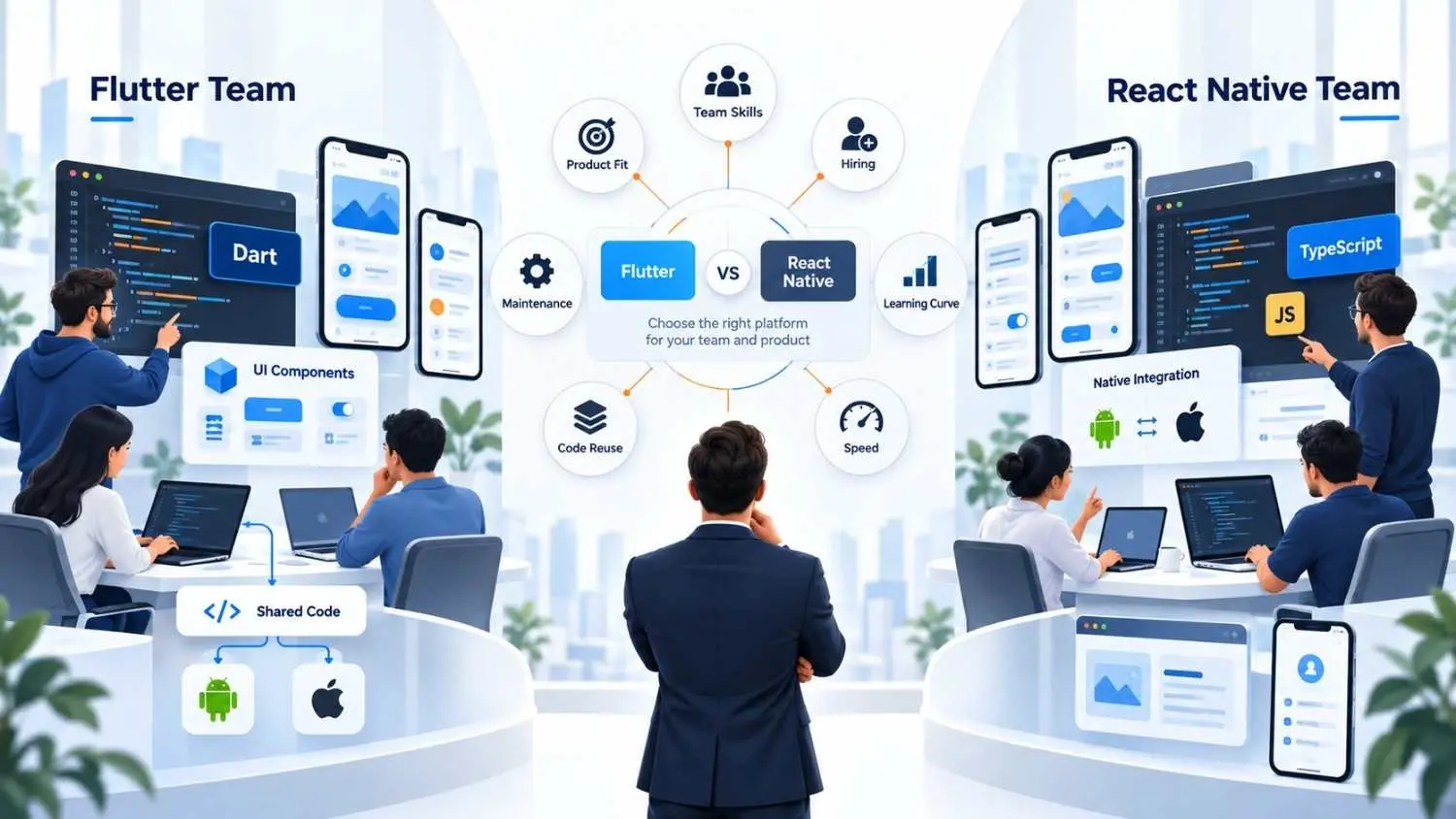
IMAGE 2 — Team and Technology Fit
This is why choosing technology without looking at the team can increase development risk. When evaluating a development partner, don't ask only:
Do you build Flutter apps?
Ask:
Why would you choose Flutter over React Native for this product?
A capable mobile team should be able to recommend either framework—or recommend neither. For businesses still selecting a development partner, IntuivoTech Mobile App Development Services provides a relevant reference for its mobile engineering, native, cross-platform, backend, testing, deployment, and support capabilities.
Flutter vs React Native for Native Device Features
Both frameworks can communicate with native platform functionality. But the amount of native customization required matters. Typical integrations include:
- Camera
- GPS
- Bluetooth
- Biometrics
- NFC
- Health data
- Background services
- Local notifications
- File systems
- Platform SDKs
If a mature plugin or package already supports your requirement, implementation can be straightforward. If not, developers may need to write platform-specific Swift/Kotlin code. That changes:
- Development effort
- Required skill set
- Testing
- Maintenance
- Cost
This is why a simple statement such as:
Cross-platform apps are cheaper.
is incomplete. They can reduce duplicate work. But the savings depend on how much code can actually remain shared.
Flutter vs React Native for Maintenance
This is one of the most important sections for a business—and one of the least exciting sections in most framework comparisons. Your app may live for five years. The launch framework decision affects:
- Hiring
- Dependency upgrades
- Plugin compatibility
- OS upgrades
- Security updates
- Framework migrations
- Knowledge transfer
- Debugging
- Feature development
Flutter's own architecture guidance emphasizes maintainability, scalability, testability, and making growing codebases easier for teams to work on. React Native is also continuing to mature its public API. React Native 0.87's Strict TypeScript API, for example, is intended to create a more clearly defined and stable public interface, though upgrading existing applications can still require migration work.
The Real Maintenance Question
Don't ask: “Which framework needs fewer updates?” Ask: “Which framework can our organization realistically maintain well?” A framework your team understands deeply can be safer than a theoretically superior framework nobody internally understands.
Flutter vs React Native Cost
There is no reliable universal answer to: “Is Flutter cheaper than React Native?” Your development cost depends on far more than framework choice. Major factors include:
- Number of features
- UI complexity
- Backend development
- Third-party APIs
- Payment systems
- Native integrations
- Admin dashboard
- Security
- Testing
- Cloud infrastructure
- Product management
- Ongoing maintenance
Existing Team Skills Change the Equation
If your company already has React/TypeScript developers, React Native may reduce onboarding effort. If your chosen Flutter app development company already has a mature Flutter team and reusable architecture, Flutter may be equally efficient. If your project requires significant native development regardless of framework, the expected cross-platform savings may shrink. For a deeper cost breakdown, explore IntuivoTech Mobile App Development Services, which explains the major factors that influence mobile app development cost.
Flutter vs React Native for Startups and MVPs
Startups often assume the answer is automatically whichever framework launches fastest. That misses the bigger question: What happens after the MVP works? Your MVP may become:
- The production product
- A funded startup platform
- An ecommerce ecosystem
- A SaaS companion app
- A product supporting hundreds of thousands of users
Choose an MVP technology you can continue operating with if the product succeeds.
Flutter Can Make Sense When:
- You need iOS and Android quickly.
- The UI is highly customized.
- The team already knows Flutter/Dart.
- Cross-platform visual consistency matters.
React Native Can Make Sense When:
- Your product team already uses React.
- You have TypeScript/JavaScript developers.
- Web and mobile teams need similar development skills.
- You expect React talent to remain part of your organization.
The Startup Rule
Don't optimize only for launch day. Optimize for the 18 months after launch too.
Flutter vs React Native for Ecommerce Apps
Both frameworks can be used for ecommerce applications.
For a commerce-specific build, see the Ecommerce Mobile App Development Guide. An ecommerce app may need:
- Product catalog
- Search
- Filtering
- Cart
- Checkout
- Payments
- Customer accounts
- Wishlists
- Push notifications
- Order tracking
- Analytics
- Shopify or custom APIs
In this type of product, the mobile framework may be less important than:
- API performance
- Catalog architecture
- Checkout reliability
- Payment integration
- Image optimization
- Analytics
- Backend scalability
If the project is ecommerce-focused, you can also review IntuivoTech Mobile App Development Services for cross-platform, backend/API, testing, and ongoing support capabilities.
Flutter vs React Native for SaaS and Business Apps
For SaaS and internal business applications, consider your existing technology organization. If your company already builds web products in React, React Native can give teams a familiar ecosystem. If the mobile experience requires a distinctive, highly controlled UI across both platforms, Flutter can be compelling. But also examine:
- Authentication
- Role-based access
- APIs
- Offline data
- Notifications
- Analytics
- Enterprise SSO
- Data security
- Admin tools
Those requirements often influence architecture far more than the framework choice.
When Should You Choose Flutter?
Flutter deserves serious consideration when:
- You want strong visual consistency.
- Your interface is highly customized.
- You need Android and iOS from a shared codebase.
- Your development team already understands Dart.
- You may explore Flutter's wider supported platforms.
- The product has animation-heavy or design-led experiences.
When Should You Choose React Native?
React Native deserves serious consideration when:
- Your team already works with React.
- TypeScript is part of your existing stack.
- Hiring within the React/JavaScript ecosystem matters.
- The mobile product fits naturally with existing React development practices.
- You want close access to native mobile capabilities while retaining a shared React-based application layer.
React Native's current direction also shows continued investment in its New Architecture, Hermes, TypeScript API, tooling, Android integration, and iOS development workflow.
When Should You Choose Native Development Instead?
Sometimes the correct answer to Flutter vs React Native is: Neither. Native development may be more appropriate when:
- You need extremely platform-specific experiences.
- Advanced iOS or Android APIs are central to the product.
- Hardware interaction is unusually complex.
- Platform performance requirements are very specialized.
- Android and iOS applications intentionally need different capabilities.
- The mobile product itself is the company's core technology and maximum platform control matters.
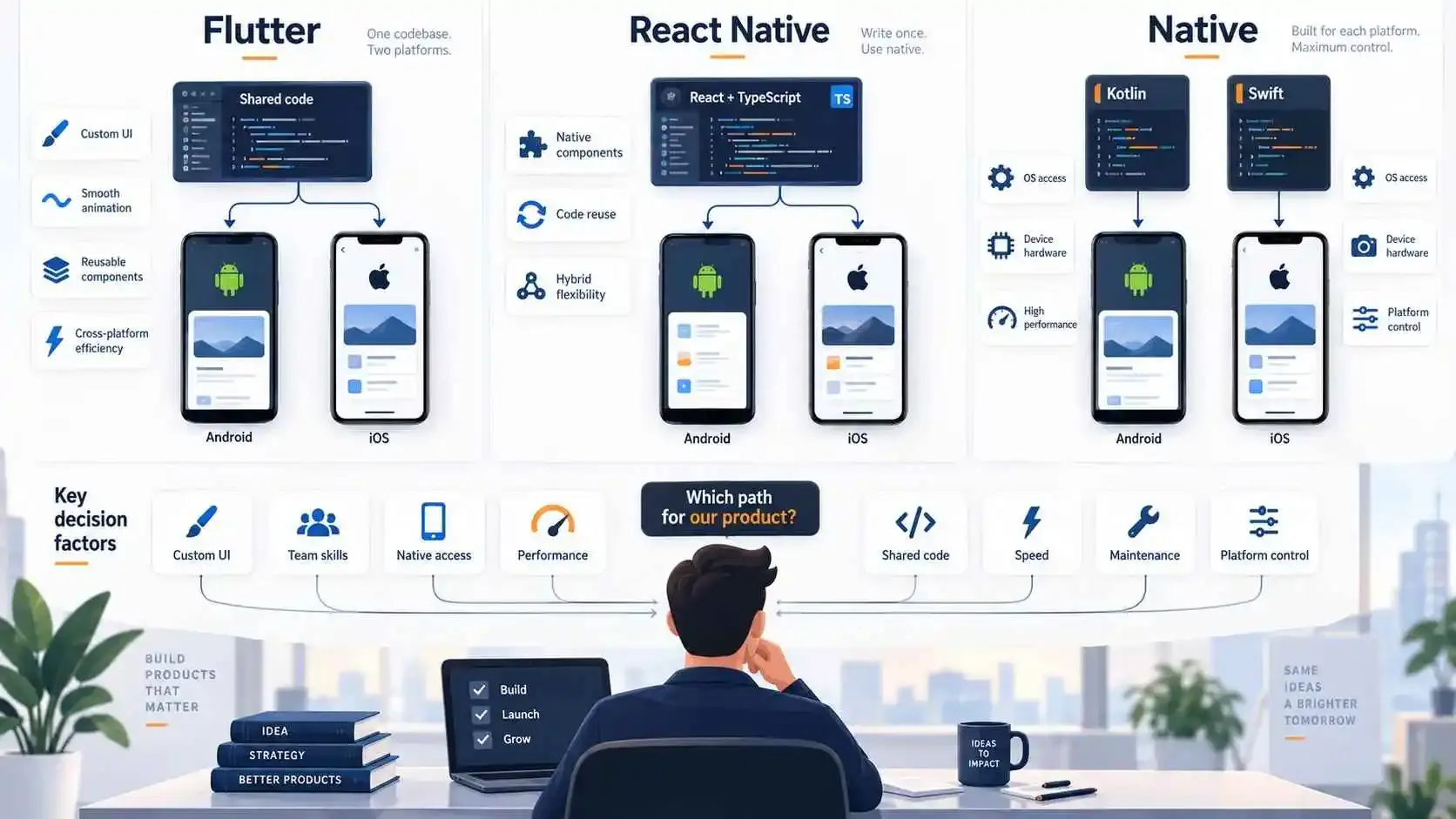
IMAGE 3 — Flutter vs React Native vs Native
A good mobile app development company should be willing to recommend native development when it genuinely fits better.
When evaluating vendors, use the How to Choose a Mobile App Development Company guide. If every project receives the same technology recommendation, you are not seeing technology strategy. You are seeing the company's preferred staffing model.
A 7-Question Framework for Choosing Flutter vs React Native
Before selecting either framework, answer these seven questions.
1. What Skills Does Our Current Team Have?
React expertise may favor React Native. Existing Dart and Flutter experience may favor Flutter.
2. How Custom Is the UI?
Highly controlled cross-platform interfaces may strengthen Flutter's case.
3. How Much Native Integration Do We Need?
List every device API and native SDK before deciding.
4. Are We Building Only Mobile?
Flutter also officially supports web and desktop targets, which may matter for some product roadmaps.
5. Who Will Maintain the App?
Think beyond the development vendor. Who owns the app in year two?
6. Which Libraries Are Critical?
Validate important SDKs and packages before development. Do not discover six months later that a critical integration is poorly supported.
7. What Would Make Us Rewrite the App?
This is perhaps the most important question. Identify framework risks before you commit.
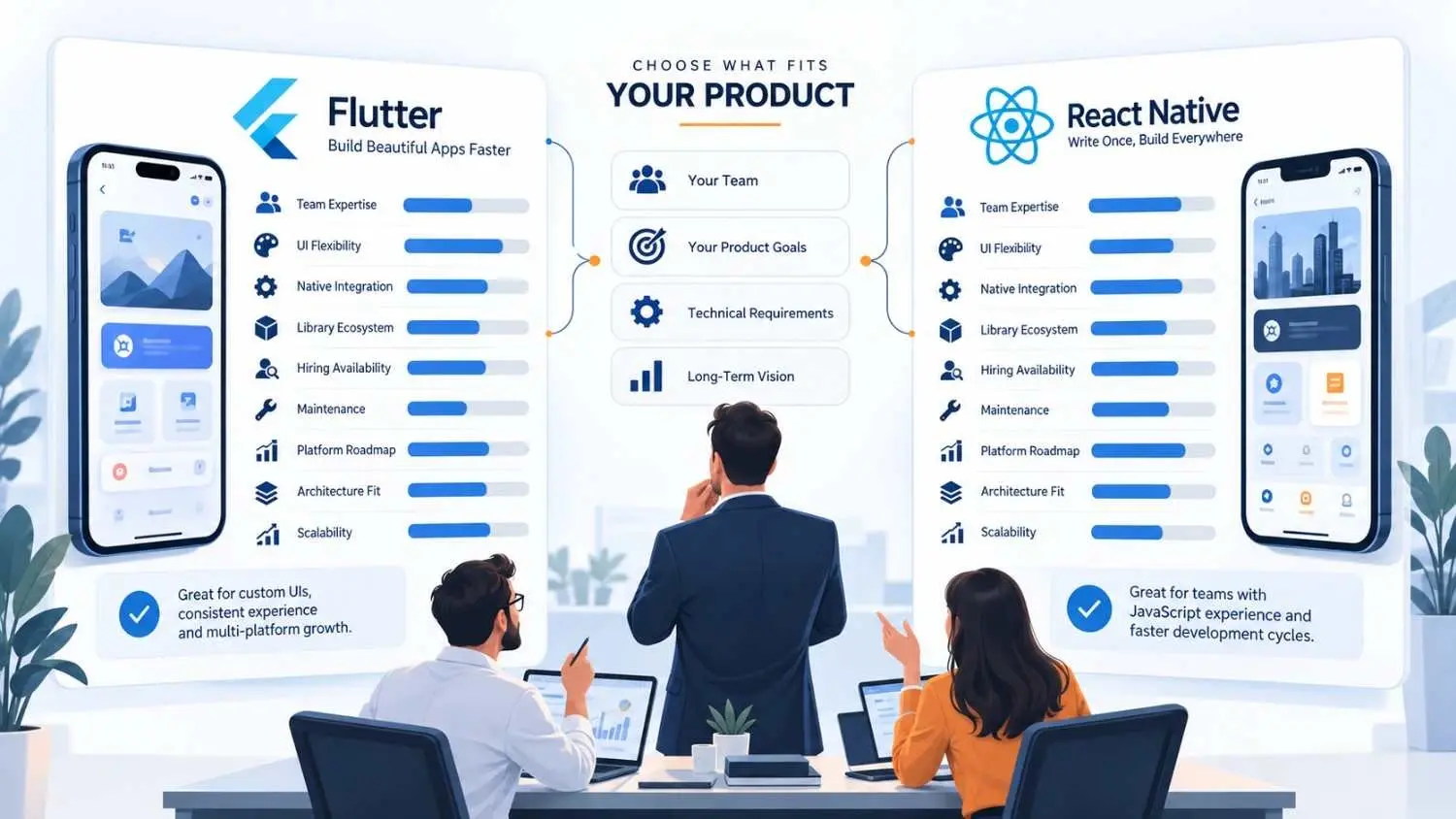
Use This Decision Scorecard
Score each factor from 1 to 5 based on your actual product.
| Decision Factor | Flutter | React Native |
|---|---|---|
| Existing team expertise | /5 | /5 |
| UI requirements | /5 | /5 |
| Native integrations | /5 | /5 |
| Library availability | /5 | /5 |
| Hiring considerations | /5 | /5 |
| Maintenance fit | /5 | /5 |
| Platform roadmap | /5 | /5 |
| Architecture fit | /5 | /5 |
\
Do not copy someone else's scores. The entire point is that your requirements determine the winner.
IMAGE 4 — Business Decision Scorecard
Common Flutter vs React Native Decision Mistakes
Choosing Based on One Benchmark
A synthetic performance test is not your production application.
Choosing Whatever Is Trending
Framework popularity does not automatically translate into product fit.
Ignoring Backend Architecture
Your app may depend more on APIs and databases than on the UI framework.
Assuming 100% Code Sharing
Platform-specific development still exists.
Ignoring Developer Availability
Someone must maintain the product after launch.
Choosing Before Auditing Integrations
Check payments, analytics, maps, authentication, hardware SDKs, and other critical dependencies first.
Forgetting the Upgrade Path
Frameworks evolve. Your development plan should include dependency and framework upgrades.
How IntuivoTech Approaches Flutter vs React Native Decisions
At IntuivoTech, the framework should follow the business and product requirements—not the other way around. The decision starts by understanding:
- Target users
- Required platforms
- Core workflows
- UI complexity
- Existing technology
- Backend requirements
- Native integrations
- Security needs
- Product roadmap
- Internal team skills
- Maintenance expectations
Only then should the development team decide whether Flutter, React Native, native Android/iOS, or another architecture is appropriate. IntuivoTech positions itself around scalable custom software, product development, cloud systems, full-stack development, and technology strategy rather than a single framework. Its current technology stack also includes React, TypeScript, Node.js, AWS, Firebase, REST, GraphQL, Python, PostgreSQL, and MongoDB. Mobile App Development Services Bespoke Software Development Services IntuivoTech Homepage
Flutter vs React Native FAQs
Is Flutter Better Than React Native in 2026?
Neither framework is universally better. Flutter can be particularly attractive for highly customized and visually consistent cross-platform interfaces, while React Native can be especially practical for organizations already working with React and TypeScript. Your product requirements should decide.
Is React Native Slower Than Flutter?
It is too simplistic to say React Native is always slower. React Native's architecture has changed significantly, including the New Architecture and the newer Hermes engine. Real performance depends heavily on the application's architecture, code quality, APIs, rendering workload, and native integrations.
Which Is Better for Startups: Flutter or React Native?
Both can work well for startups. React Native may be attractive to teams already using React/TypeScript. Flutter may be attractive when custom UI and cross-platform visual consistency are high priorities. Choose based on the team you have and the product you expect to maintain after the MVP.
Which Is Better for Ecommerce Apps?
Both Flutter and React Native can support ecommerce applications. Backend architecture, payment reliability, catalog APIs, checkout, analytics, search, and application performance often matter more than the framework itself.
Is Flutter Cheaper Than React Native?
Not automatically. Costs depend on team expertise, application complexity, native modules, backend systems, integrations, testing, and maintenance.
Can Flutter and React Native Handle Large Applications?
Both can be used for complex production applications. Architecture, modularity, testing, state management, backend design, and development practices become increasingly important as the product grows.
Which Framework Is Easier to Maintain?
The framework your organization can support consistently is often easier to maintain. Existing team skills, third-party libraries, code architecture, documentation, and upgrade practices all affect maintenance.
Should I Use Native Development Instead?
Possibly. If your product relies heavily on platform-specific APIs, specialized hardware functionality, or deeply different iOS and Android experiences, native development should be evaluated alongside cross-platform options.