Two mobile app development companies can look almost identical on paper.
Both may show polished designs. Both may say they work with React Native, Flutter, iOS, Android, AWS, and AI. Both may promise an experienced team and an agile development process.
Then one quotes $35,000.
Another quotes $90,000.
A third refuses to give you a number until it understands the product.
Which one should you trust?
That is where choosing an app development partner becomes more difficult than searching Google for the best mobile app development companies.
You are not really buying code.
You are choosing the team that may influence your product architecture, user experience, security, launch timeline, cloud costs, technical debt, and ability to improve the application after launch.
So instead of asking:
Which company makes the best apps?
Ask:
Which company can show that it understands my product, can make sound technical decisions, and can reliably own the work after development starts?
This guide gives you a practical framework for doing exactly that.
How Do You Choose a Mobile App Development Company?
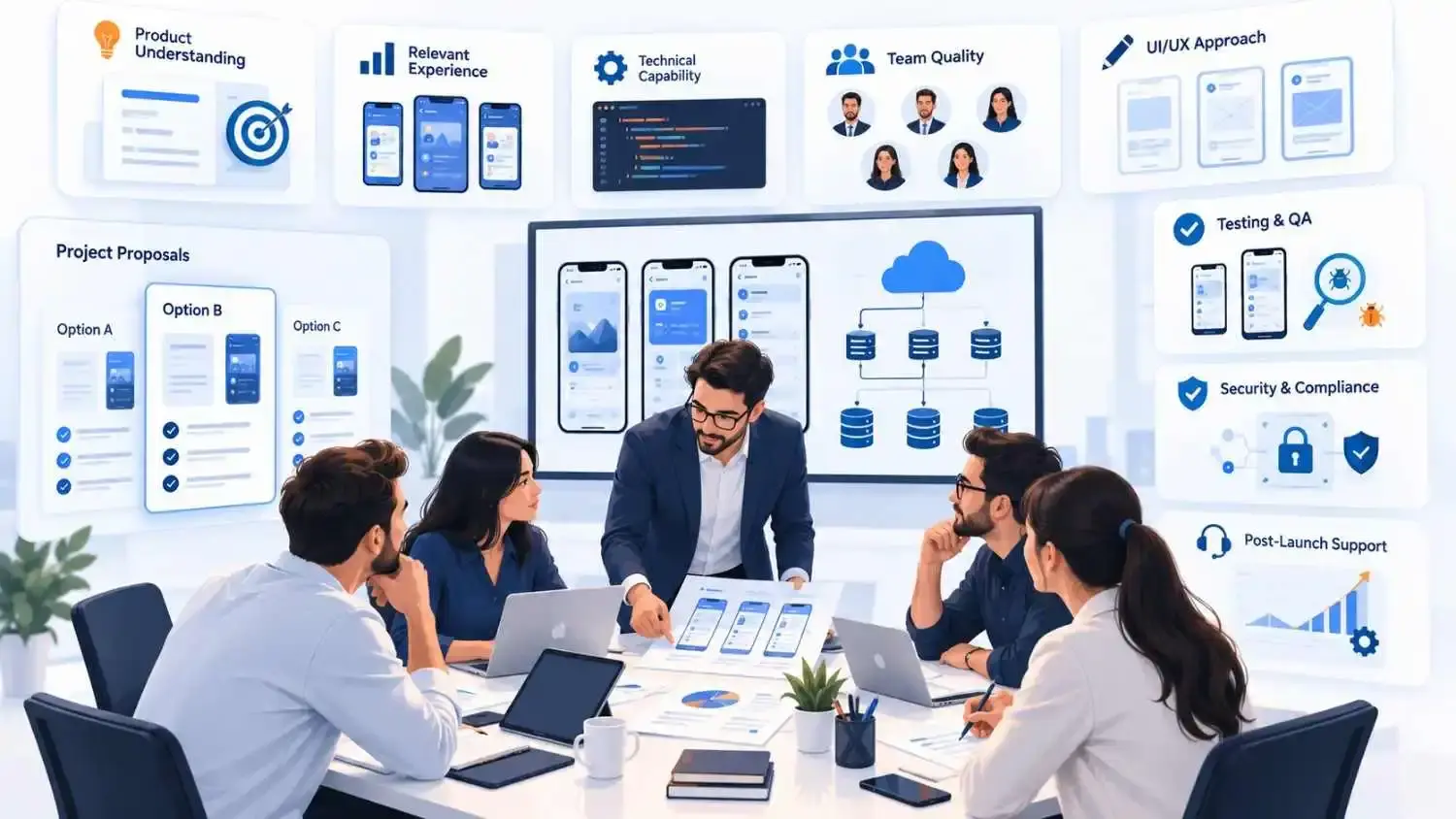
To choose a mobile app development company, evaluate these areas before comparing price:
- Product understanding
- Relevant project experience
- Technical architecture skills
- Mobile platform expertise
- Backend and API capabilities
- UI/UX process
- Testing standards
- Security practices
- Communication and project governance
- App Store and Google Play experience
- Source-code and IP ownership
- Post-launch maintenance
The important part is not whether the company says it does these things.
Ask for evidence of how it does them.
That small difference can tell you far more than a 40-page sales presentation.
[IMAGE 2 – MOBILE APP COMPANY EVALUATION CHECKLIST HERE]
Image: Mobile app in the center surrounded by checkpoints for product understanding, portfolio, technical expertise, backend, UI/UX, QA, security, communication, ownership, and post-launch support.
ALT Text: Checklist for choosing the right mobile app development company
Step 1: Create a One-Page App Brief Before Contacting Companies
A common mistake is contacting ten app developers with an idea such as:
I need an ecommerce app similar to Amazon. What will it cost?
You will receive ten completely different estimates because every company is making different assumptions. Before comparing vendors, create a simple one-page brief. Include:
- What problem the app solves
- Who will use it
- Android, iOS, or both
- Core features
- Nice-to-have features
- Existing website or software
- Required integrations
- Expected user types
- Payment requirements
- Admin-panel requirements
- Approximate launch goal
- Known compliance or security requirements\
You do not need a complete technical specification. You simply need enough consistency so every app development company is evaluating roughly the same project.\
If the product scope is still unclear, the Mobile App Development Process Guide can help structure discovery, MVP planning, architecture, testing, and launch.
Why This Matters
Imagine Company A assumes you need:
- Mobile application
- Custom backend
- Admin panel
- Payment gateway
- Push notifications
- Analytics
- Cloud infrastructure
Company B assumes your existing backend will handle everything. Their prices cannot be compared fairly. Rule: Compare vendors only after giving them the same problem to solve.
1. Check How They Think Before Checking What They Built
The strongest signal often appears during the first discovery conversation. A weak vendor immediately starts selling. A stronger product team starts asking questions. They may ask:
- Why does this feature need to exist?
- Who is the primary user?
- What needs to be in version one?
- Does the product really need native development?
- What existing APIs are available?
- Which feature represents the biggest technical risk?
- What happens if usage increases significantly?
- Which assumptions have already been validated?
A good mobile app development company should not simply accept your requirements as instructions. It should help identify which requirements make sense. That does not mean the developer should control your product. It means technical decisions should involve discussion rather than automatic agreement. If you are still defining the product itself, review IntuivoTech Mobile App Development Services to understand how discovery, product strategy, architecture, design, development, testing, deployment, and support fit into the complete development lifecycle.
2. Look for Relevant Experience, Not a Huge Portfolio
A portfolio with 100 applications sounds impressive. But one relevant application may tell you more. Suppose you are building a healthcare application that involves:
- Patient accounts
- Appointment booking
- Sensitive information
- Notifications
- Multiple user roles
\
A development company that has built similar workflows may be more relevant than an agency with dozens of unrelated entertainment apps. Look for similarity in:
Business Model
Marketplace, SaaS, ecommerce, healthcare, enterprise, subscription, logistics, and similar models.
Technical Complexity
Payments, real-time data, APIs, offline capability, maps, video, authentication, integrations, and custom business logic.
Scale
A small internal application and a customer-facing platform serving large numbers of users create very different technical requirements.
Ask This Instead of “Show Me Your Portfolio”
Ask: “Show me the project in your portfolio that is technically closest to ours, and explain what made it difficult.” The explanation is often more useful than the screenshots.
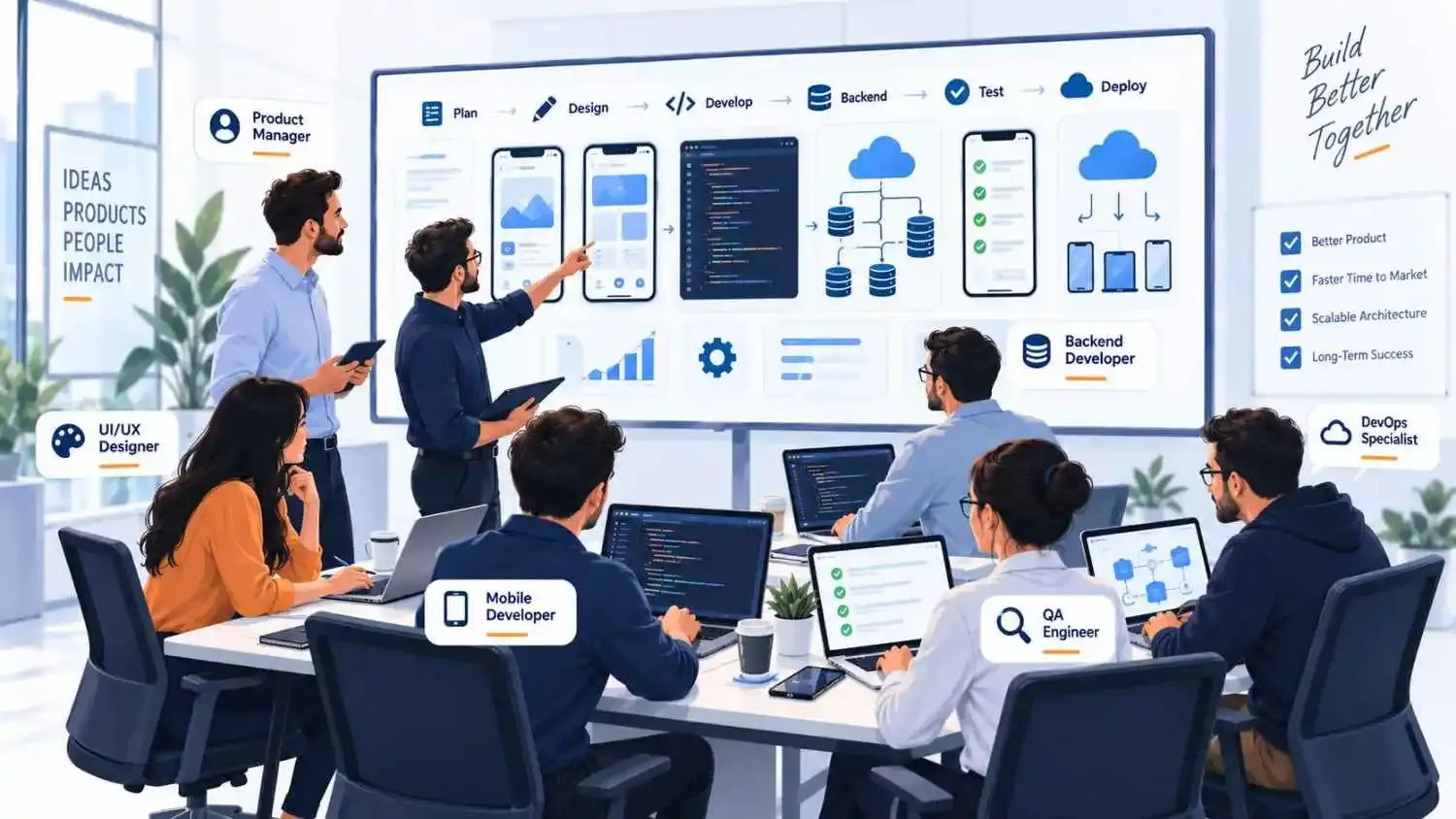
3. Ask Who Will Actually Build Your App
This is one of the most overlooked checks. You may spend your sales calls speaking with:
- Founder
- CTO
- Senior architect
- Senior developer
Then discover after signing that your day-to-day team is completely different. Before hiring a mobile app development agency, ask:
- Who is the technical lead?
- Who is the project manager?
- How senior are the developers?
- Is QA part of the core team?
- Is UI/UX done internally?
- Is backend development done internally?
- Will anyone be subcontracted?
- Can I meet the technical lead before signing?
You do not need to interview every developer. But you should understand the team structure you are purchasing.
4. Make Them Explain the Architecture in Plain English
A reliable development partner should be able to explain technology choices without hiding behind technical vocabulary. For example: Why Flutter instead of native development? Why React Native? Why Kotlin? Why Swift? Why PostgreSQL instead of MongoDB? Why AWS? Why serverless? Why does the app need a custom backend? The answer should connect technology to your product. For example:
Because you need Android and iOS at launch, your features do not depend heavily on platform-specific hardware, and your team wants a shared maintenance path, cross-platform development may be worth evaluating.
That is more useful than:
Flutter is the best technology.
There is rarely one technology that is automatically best for every product. IntuivoTech Mobile App Development Services include native Android, native iOS, Flutter, React Native, backend APIs, cloud infrastructure, and cross-platform applications. The important part is selecting between them based on product requirements rather than framework popularity.
For a deeper comparison, read Flutter vs React Native in 2026.
5. Evaluate Backend and API Skills, Not Only Mobile Screens
A visually impressive app can still have a weak foundation. Most serious applications depend on backend systems for things such as:
- Authentication
- User accounts
- Payments
- Databases
- Notifications
- Search
- Business logic
- Admin dashboards
- File storage
- Analytics
- Third-party integrations
- Permissions
- Reporting
Ask the development company: “Who owns backend architecture?” Then ask how the application will communicate with:
- Your CRM
- ERP
- Payment provider
- Existing website
- Inventory system
- Customer database
- Analytics platform
- Internal software
If your project includes complex workflows beyond the mobile application itself, a team with Bespoke Software Development capabilities may be more appropriate than a mobile-only developer.
For ecommerce-specific projects, also review the Ecommerce Mobile App Development Guide.
6. Test Their UI/UX Process
Do not judge UI/UX ability only by attractive portfolio screens. Good app design is primarily about helping the user complete a task. Ask to see how the company moves from: User Flow → Wireframe → Prototype → Visual Design → Development. Suppose you are building an ecommerce checkout. The question is not: “Does this checkout look modern?” The better questions are:
- Can customers understand what happens next?
- Are unnecessary steps removed?
- What happens when payment fails?
- Is validation clear?
- Can the flow handle different addresses?
- What happens on poor internet?
- What happens if inventory changes during checkout?
Good UI/UX covers happy paths and uncomfortable paths.
7. Ask for Evidence of the Testing Process
“We test everything” tells you almost nothing. Ask what testing actually includes. A credible process may cover:
- Functional testing
- API testing
- UI testing
- Regression testing
- Performance testing
- Security testing
- Device compatibility
- Operating-system compatibility
- Poor-network testing
- Payment testing
- Crash monitoring
Also ask: “Which real devices will you test our application on?” Emulators are useful, but customers use physical devices with different:
- Screen sizes
- OS versions
- Memory
- Network conditions
- Hardware
For a business application, testing should be part of the development process rather than a final activity performed just before launch.
8. Discuss Security Before Development Starts
Do not wait until launch week to ask how customer data will be protected. Security decisions can affect architecture from the beginning. Depending on your application, discuss:
- Authentication
- Authorization
- Encryption
- API security
- User permissions
- Secrets management
- Payment processing
- Secure data storage
- Logging
- Backups
- Infrastructure access
- Dependency management
- Compliance requirements
A healthcare application may require different controls from an ecommerce application. A financial product may have different risk requirements from an internal employee tool. The developer should understand the difference. Be cautious if security conversations are reduced to:\
Don't worry, our code is secure.
Ask how.
9. Understand How the Project Will Be Managed
Many technology projects do not fail because developers cannot code. They fail because expectations slowly separate. You thought Feature A included three workflows. The vendor thought it included one. You expected weekly releases. The vendor expected monthly reviews. You assumed changes were included. They assumed every change required a new estimate. Before signing, establish:
- Sprint length
- Update frequency
- Demo frequency
- Project-management tool
- Who approves work
- Change-request process
- Escalation process
- Acceptance criteria
- Documentation expectations
- Release ownership
You should know what a normal Monday looks like after development begins.
10. Clarify Who Handles App Store and Google Play Deployment
Building an application and successfully taking responsibility for release are not the same task. Ask specifically:
- Who prepares production builds?
- Who handles signing and certificates?
- Who prepares store submissions?
- Who manages store-review feedback?
- Who handles rejected submissions?
- Who configures production environments?
- Who owns the Apple and Google developer accounts?
As a general business-control principle, important production accounts should remain under your organization's control wherever practical. You do not want to discover after launch that essential accounts, credentials, or services are accessible only through a former vendor. IntuivoTech Mobile App Development Services include Apple App Store and Google Play deployment as part of the development lifecycle.
11. Put Source Code, IP, and Account Ownership in Writing
Do not leave ownership to assumptions. Your contract should clearly explain who owns:
- Source code
- Application designs
- Documentation
- Domains
- Cloud accounts
- Databases
- App Store accounts
- Google Play accounts
- Third-party service accounts
- Intellectual property created for the project
Also ask how the source code will be managed. Ideally, you should have visibility into the repository during development rather than receiving a mysterious ZIP file after final payment. If you are commissioning custom technology, long-term control matters. IntuivoTech Bespoke Software Development Services are designed for businesses that require custom architecture, integrations, workflows, and complete software ownership.
12. Understand What Happens After Launch
Launch day is the beginning of product operations. After release, you may discover:
- Device-specific bugs
- New OS issues
- API changes
- Performance bottlenecks
- Customer feedback
- Security updates
- New feature requirements
- Store-policy changes
Ask your app development firm:
- What is the warranty period?
- What counts as a bug?
- What counts as a new feature?
- How quickly are critical issues handled?
- Is monitoring included?
- How are OS updates managed?
- How is maintenance priced?
- Can another development team take over later?
A healthy development relationship should not create technical dependency. It should leave your business with understandable software, documentation, and ownership.
Give Every Company the Same Difficult Scenario
Here is one technique that can reveal far more than asking another generic question. Give every shortlisted vendor the same scenario. For example:
“We launch with 10,000 users. Six months later we reach 300,000 users, add subscription payments, and need an enterprise customer to use single sign-on. What parts of your proposed architecture might need to change?”
You are not looking for one perfect technical answer. You are evaluating how they think. Do they:
- Ask questions?
- Identify assumptions?
- Explain tradeoffs?
- Mention cost?
- Discuss database or infrastructure impact?
- Think about security?
- Consider migration?
- Admit uncertainty?
This makes it much easier to compare actual technical reasoning.
Freelancer vs Mobile App Development Company vs In-House Team
The right model depends on the product.
| Option | Often Suitable For | Things to Consider |
|---|---|---|
| Freelancer | Small applications, prototypes, narrow technical tasks | Limited bandwidth and specialist coverage |
| Mobile app development company | Complete product delivery requiring design, backend, mobile, QA, and deployment | Higher initial cost than an individual freelancer |
| In-house team | Products requiring continuous long-term development | Recruiting time, salaries, management, and infrastructure |
| Hybrid model | Companies with internal product leadership but external development needs | Requires clear ownership between teams |
When a Freelancer Makes Sense
A freelance mobile app developer can work well when:
- Scope is small
- Architecture is already defined
- You have internal technical oversight
- One specialist skill is needed
When an App Development Company Makes More Sense
A full development company may be more suitable when the project needs several capabilities working together:
- Product planning
- UI/UX
- Android/iOS development
- Backend
- APIs
- QA
- DevOps
- Security
- App-store deployment
- Maintenance
The value is not simply “more developers.” It is access to multiple disciplines under one delivery structure.
Local vs Offshore Mobile App Development Company
A company does not automatically become better because it is local. It also does not automatically become better because offshore development costs less. Evaluate the operating model instead.
For Any Local or Offshore Partner, Check:
Communication: Can the team explain problems clearly? Timezone overlap: Will there be enough working-hour overlap for important discussions? Project ownership: Do they proactively manage risks or wait for instructions? Technical expertise: Can they demonstrate relevant capabilities? Contracts: Are ownership, confidentiality, deliverables, and payment terms clear? Continuity: What happens if a key developer leaves? Support: Can production incidents be handled when customers are affected? Location matters. But working practices matter more.
How Much Does It Cost to Hire a Mobile App Development Company?
There is no useful universal price for a mobile application. The quote depends on what is actually being built. Major cost drivers include:
- App complexity
- Number of platforms
- Native vs cross-platform development
- UI/UX complexity
- Backend requirements
- Admin panel
- User roles
- Third-party integrations
- Payment systems
- Security requirements
- Testing
- Cloud infrastructure
- Maintenance
Instead of asking: “How much does an app cost?” Ask: “What assumptions are included in this estimate?” Two proposals may both say “mobile app development” while including completely different responsibilities.
Compare Proposals Line by Line
Check whether each estimate includes:
- Discovery
- UX
- UI design
- Mobile development
- Backend
- Admin dashboard
- APIs
- QA
- DevOps
- Deployment
- Project management
- Documentation
- Warranty
- Maintenance
This makes app development companies' costs easier to compare fairly.
Fixed Price vs Time and Materials
Neither pricing model is automatically better.
Fixed Price
Works best when:
- Scope is clearly defined
- Changes are unlikely
- Deliverables are measurable
Watch for unclear change-request terms.
Time and Materials
Works best when:
- Product requirements may evolve
- Discovery is still happening
- Features will be validated during development
It provides flexibility but requires strong transparency.
Dedicated Team
Can work well when:
- Development will continue for months or years
- Priorities change regularly
- You need stable development capacity
Ask how the team is managed and how individual replacements are handled.
Use This Mobile App Development Company Scorecard
Do not choose the winner during the sales calls. Score every shortlisted vendor afterward.
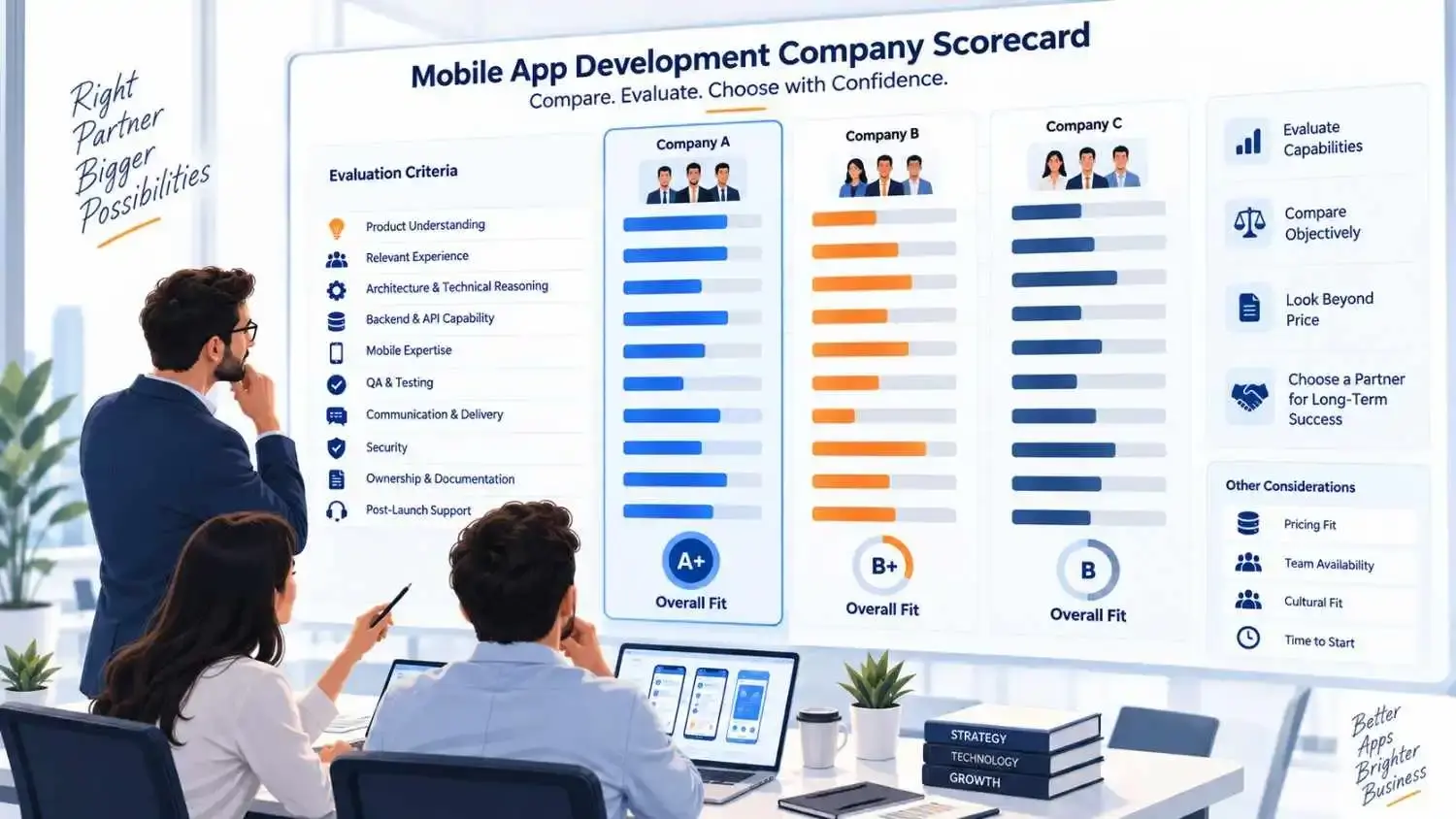
| Evaluation Factor | Suggested Weight |
|---|---|
| Product understanding | 15% |
| Relevant experience | 15% |
| Architecture & technical reasoning | 15% |
| Backend/API capability | 10% |
| Mobile expertise | 10% |
| QA & testing | 10% |
| Communication & delivery | 10% |
| Security | 5% |
| Ownership & documentation | 5% |
| Post-launch support | 5% |
Score each category from 1–5. Then calculate the weighted total.
One Important Rule
Score vendors before looking at the final price comparison. Otherwise, the cheapest or most expensive proposal can unconsciously affect how you judge everything else. Price matters. It just should not erase technical evidence.
10 Red Flags When Hiring a Mobile App Development Company
Watch carefully if a vendor:
1. Gives a Final Quote Almost Immediately
A rough range is normal. A highly specific estimate without understanding the application deserves questions.
2. Recommends Technology Before Understanding Users
“We build everything in Flutter” is not product strategy.
3. Cannot Explain Architecture Simply
Technical complexity is real. Unclear communication does not need to be.
4. Shows Designs but Cannot Discuss Backend Work
A mobile app is often only the visible layer of a much larger system.
5. Refuses Access to the Development Team
You should understand who is responsible for delivery.
6. Has No Defined QA Process
Testing should not mean developers casually testing their own screens.
7. Is Unclear About Source-Code Ownership
Resolve this before development.
8. Promises an Unrealistic Launch Date
Speed is valuable. Ignoring complexity is not.
9. Does Not Discuss Maintenance
Production software changes after launch.
10. Says Yes to Everything
A technology partner should sometimes challenge assumptions. An order-taking vendor usually will not.
15 Questions to Ask Before Hiring an App Development Company
Take these questions into vendor calls:
- What project have you built that is closest to ours?
- What part of our idea would you change before development?
- What would you remove from version one?
- Who will actually work on the project?
- Which technology would you recommend and why?
- How will the backend be designed?
- How do you test on real devices?
- How do you handle security?
- How are scope changes priced?
- How frequently will we see working software?
- Who handles Apple App Store and Google Play submission?
- Who owns the source code and intellectual property?
- What documentation will we receive?
- What happens after launch?
- If we stop working together, how does handover work?
A vendor's answers should make the project clearer. If you finish the call more confused than when it started, pay attention to that.
When Should You Choose a Custom Mobile App Development Company?
Custom development makes sense when your application requires more than standard templates or app builders can comfortably support. Common examples include:
- Proprietary business workflows
- Complex customer journeys
- Multiple user roles
- Custom dashboards
- Advanced integrations
- Marketplace functionality
- Enterprise authentication
- IoT connectivity
- AI-enabled features
- Complex data processing
- High scalability requirements
Custom software also becomes relevant when your mobile application is one component of a larger platform. For example: Mobile App ↓ API Layer ↓ Custom Backend ↓ CRM + ERP + Payments + Analytics + Internal Systems. In projects like these, evaluate the company's broader software architecture capability as carefully as its mobile development skills. IntuivoTech provides both Mobile App Development Services and Bespoke Software Development Services for products that extend beyond a standalone mobile interface.
What Makes IntuivoTech Different as a Mobile Development Partner?
This guide should work whether you eventually choose IntuivoTech or another development company. The same evaluation standards should apply to everyone. At IntuivoTech, the development approach starts with understanding the business objective, users, feature requirements, integrations, and technical constraints before defining the architecture. Its Mobile App Development Services cover:
- Product discovery and strategy
- UI/UX design
- Native Android development
- Native iOS development
- Flutter and React Native
- Backend and API development
- Cloud infrastructure
- Testing and QA
- App Store and Google Play deployment
- Maintenance and enhancement
For products involving wider workflows, integrations, SaaS platforms, customer portals, marketplaces, CRM/ERP systems, or custom business applications, its Bespoke Software Development Services extend beyond the mobile layer. You can also learn more about the people and technical experience behind the company on the IntuivoTech About Page. That broader product perspective matters because choosing a mobile framework is only one decision inside a much larger software system.
Final Checklist Before Signing the Contract
Before selecting a mobile app development company, confirm that you can answer yes to these questions:
- Do they understand the business problem?
- Have they challenged unnecessary features?
- Can they show relevant work?
- Have you met the delivery lead?
- Can they explain their architecture?
- Can they handle backend development?
- Is the testing process clear?
- Are security responsibilities defined?
- Is project communication structured?
- Are store submissions included?
- Are source code and IP ownership clear?
- Are accounts under appropriate business control?
- Is documentation included?
- Is post-launch support defined?
- Is pricing based on clear assumptions?
- Do you understand the exit and handover process?
If several answers are still unclear, the project is probably not ready to sign.
FAQs About Choosing a Mobile App Development Company
How Do I Choose a Good Mobile App Development Company?
Start by defining your product requirements. Then compare companies based on relevant experience, product thinking, mobile expertise, backend capabilities, QA process, security practices, communication, source-code ownership, deployment experience, and post-launch support. Do not select a company based on price or portfolio appearance alone.
What Should I Look for in a Mobile App Developer?
Look for evidence that the developer can understand product requirements, explain technical decisions, build maintainable software, test reliably, work with APIs and backend systems, communicate clearly, and support the application after launch.
Should I Hire a Freelancer or Mobile App Development Company?
A freelancer may be suitable for small or clearly defined projects. A mobile app development company is usually easier to consider when you need several disciplines together, such as product planning, design, mobile development, backend development, QA, DevOps, deployment, and maintenance.
How Much Does Hiring an App Development Company Cost?
The cost depends on scope, platform, features, backend systems, design requirements, integrations, security, infrastructure, QA, and ongoing maintenance. Request a scope-based estimate rather than relying on generic app-development pricing.
Is the Cheapest Mobile App Development Company a Bad Choice?
Not necessarily. A lower-priced company may be an excellent fit. The concern is not low cost itself. The concern is a low quote created by missing work such as backend development, QA, deployment, documentation, or post-launch support. Compare assumptions before comparing totals.
Should I Hire a Local Mobile App Developer?
Local teams can provide convenient timezone alignment and face-to-face collaboration, but location alone does not determine quality. Evaluate communication, experience, architecture, technical ability, delivery process, ownership, and support whether the company is local, national, or offshore.
Should I Choose Native or Cross-Platform Development?
Native development can provide deeper platform-specific integration and control. Cross-platform frameworks such as Flutter and React Native can allow teams to share a significant portion of the code across Android and iOS. The best choice depends on your users, product requirements, performance needs, integrations, budget, timeline, and long-term roadmap.
Who Should Own the Mobile App Source Code?
Ownership should be clearly stated in your contract. Businesses commissioning custom applications should understand exactly who owns the source code, designs, documentation, accounts, data, and project-specific intellectual property after development.
How Do I Know if an App Development Company Is Trustworthy?
Do not rely on a single trust signal. Combine:
- Relevant work
- Client references
- Team transparency
- Technical reasoning
- Clear contracts
- Defined ownership
- Transparent communication
- Documented QA
- Realistic estimates
- Post-launch processes
Trust should come from evidence rather than marketing claims.
Choose the Team, Not Just the Proposal
The final proposal matters. But the people behind it matter more. You are choosing a team that may make hundreds of decisions you will never see: How data is stored. How authentication works. How errors are handled. How the application performs on older devices. How quickly bugs can be fixed. How easily another developer can understand the code later. How the architecture responds when the product grows. That is why the strongest question is not: “Who can build this app?” Many companies can. Ask: “Who can explain how they would build it, why they would build it that way, what could go wrong, and how they would help us manage those risks?” When a development company can answer those questions clearly—with evidence—you are much closer to finding the right partner. If you are currently evaluating a new mobile product, explore IntuivoTech Mobile App Development Services or learn more about Intuivo Technology Solutions before starting your technical discovery.